
Roleplay for Writing

Roleplay for writing

The hardest scenes to write are the ones where you are not sure the character would really say it. Rehearsal solves that: put the character in the room, ask the hostile question, and hear what comes back — in their voice, from their motives, with their memory of the plot.

Nothing typed in a rehearsal lands in the manuscript. The output is understanding, and the transcript is there when you want to mine it for dialogue.
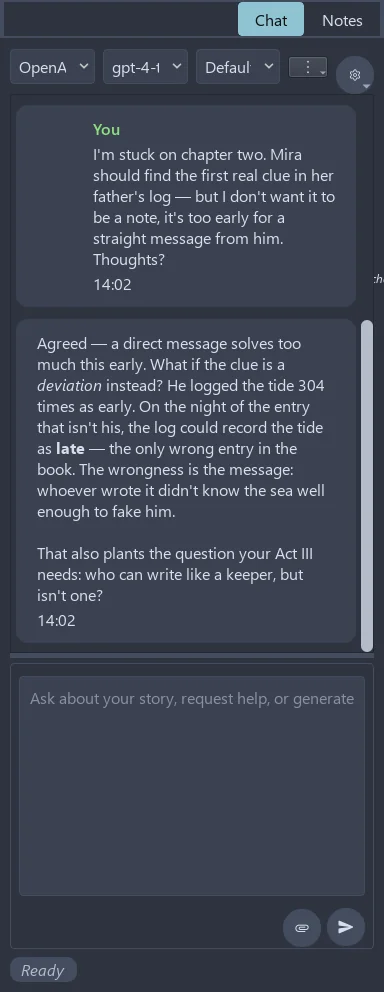
The AGIT chat panel showing a role-play conversation in character
A rehearsal in progress: the character answers from the compendium's memory, not yours.

How the rehearsal is staged

Voice profiles

Each character card can carry a voice: how they speak, what they won't say, what they want and what they fear. The role-play engine reads the profile plus the compendium entry plus what has actually happened in the draft — so in chapter twelve's rehearsal, the character does not know what you plan for chapter twenty, and cannot spoil it.

Scene setting

You set the stage: the location, who else is present, the tension level, the thing that must not be said. Then you step in as the counterparty — the detective, the betraying friend, the editor from hell — and the scene runs. End it whenever the question is answered.

What writers actually rehearse

  • The confrontation: does the antagonist's argument hold up, or did you write a straw man you will have to fix in revision?
  • The interview: interrogate your own protagonist about the plot hole you are ignoring. They will find it. They live there.
  • The dialogue test: two characters, one topic — and you learn their voices are interchangeable two chapters before a reader would have told you.
  • The world check: ask a scholar character how the magic system works. If the answer contradicts chapter four, better now than in the reviews.

After the rehearsal

From transcript to draft

A good line from a rehearsal is yours to keep: copy it into the scene, or keep the transcript as a note on the character's card. When you are done rehearsing, the manuscript is exactly where you left it — untouched, because play belongs to the chat panel, not the page.

The other door, for when the manuscript needs a break instead: roleplay for fun.